10 Common Signs: How to Spot Fake Pokémon Cards Like a Pro
Introduction
As the Pokémon Trading Card Game continues to skyrocket in global popularity, counterfeit products have become incredibly common across online marketplaces, auctions, and private sales. While many bootleg items may look convincing at first glance, they often contain small manufacturing flaws that reveal their true nature.
Whether you are a complete beginner or a seasoned veteran, mastering how to spot fake Pokémon cards is essential to protect your hard-earned collection. This definitive guide breaks down ten critical warning signs so you can analyze cardboard with absolute confidence.
How to Spot Fake Pokémon Cards: Look for Poor Print Quality and Font Issues
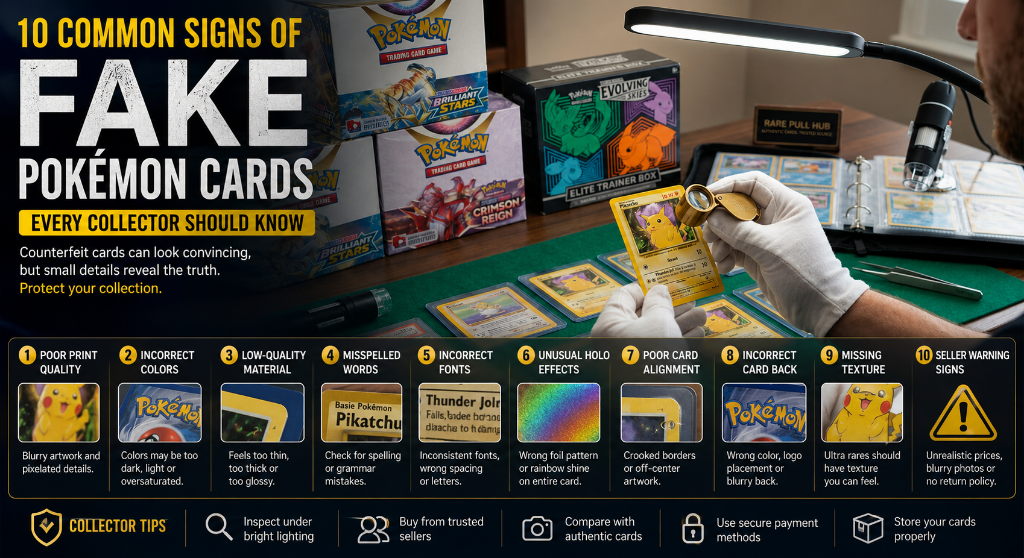
Authentic Pokémon cards pass through highly advanced, industrial manufacturing processes. Consequently, official prints feature incredibly sharp graphics and uniform text layouts. When you are evaluating an item, poor print quality is usually the first major red flag. Keep an eye out for blurry artwork, pixelated images, faded colors, or smudged inks.
Furthermore, you must pay close attention to the card typography. Fake cards frequently contain glaring spelling mistakes or grammar errors within attack descriptions and card names. Additionally, counterfeiters often use incorrect font types that appear too bold, unevenly spaced, or completely misaligned compared to official set checklists.
How to Spot Fake Pokémon Cards: Check the Material, Colors, and Texture
The physical feel of the cardboard is another massive giveaway. Genuine cards are constructed using premium, layered cardstock that provides a sturdy, stiff structure. In contrast, fake cards often feel way too thin, flimsy, or awkwardly glossy.
To inspect a piece accurately, utilize these three material checks:
- Color Balance: Fake cards typically display oversaturated backgrounds or highly washed-out tones.
- The Card Back: Look closely at the reverse side. Counterfeits routinely feature dark blue borders or messy, bleeding graphics.
- Surface Texturing: Most modern high-rarity cards possess fine, intricate embossed textures across the artwork. If a premium card feels completely smooth under your finger, it is highly likely a counterfeit.
How to Spot Fake Pokémon Cards: Inspect Holographic Effects and Alignment
Advanced holographic patterns are highly difficult for counterfeit operations to replicate accurately. Authentic ultra-rare items showcase dynamic light reflections that move elegantly across the surface layout. Conversely, cheap replicas often feature a flat, vertical rainbow foil sheen that blankets the entire card unnaturally.
While you are looking at the card face, check the overall border alignment as well. Though minor off-centering can happen during official factory cutting, extreme tilt, crooked borders, or heavily uneven margins deserve immediate suspicion. If the holographic reflection or geometric frame looks off, proceed with extreme caution.
Conclusion: Protect Your Vault with Rare Pulls Hub
Learning how to spot fake Pokémon cards is an invaluable skill that shields your financial capital and keeps the hobby enjoyable. By carefully inspecting print sharpness, fonts, textures, and card stocks, you can spot bootleg products before making an expensive mistake.
The absolute safest defense against counterfeits is buying directly from a verified source. At Rare Pulls Hub, we take authenticity seriously. We thoroughly evaluate our inventory so you can expand your vault with complete peace of mind. Whether you are hunting for factory-sealed booster boxes, pristine raw singles, or certified graded slabs, we are dedicated to providing a secure shopping experience. Explore our secure storefront, browse our latest arrivals, and learn how to spot fake Pokémon cards using our verified collector inventory today!
Frequently Asked Questions
Can fake Pokémon cards actually look real?
Yes, absolutely. Modern counterfeit operations have become highly sophisticated, making microscopic inspection and texture checks incredibly important for high-value items.
Is every off-center card automatically a fake?
Not necessarily. Minor centering variations happen naturally during mass factory printing. However, if extreme misalignment is paired with blurry text or incorrect colors, it is likely a counterfeit.
What basic tools should I use to inspect my cards?
Many serious enthusiasts utilize a bright LED desk lamp, a UV flashlight, and a 10x jeweler’s loupe. These tools allow you to spot hidden print patterns, missing textures, and incorrect paper layers easily.